Investment Strategy - Central Bank Transition Raises Defensive Bias
BI enters a leadership transition BI Governor Perry Warjiyo has officially resigned, according to the State Secretariat’s announcement on 27 July 2026. During the transition, BI Senior Deputy Governor Destry Damayanti will serve as acting Governor, while the Board of Governors continues to operate on a collegial basis under the BI Law. This is a highly sensitive development for markets given its implications for policy credibility and continuity.
BI enters a leadership transition
BI Governor Perry Warjiyo has officially resigned, according to the State Secretariat’s announcement on 27 July 2026. During the transition, BI Senior Deputy Governor Destry Damayanti will serve as acting Governor, while the Board of Governors continues to operate on a collegial basis under the BI Law. This is a highly sensitive development for markets given its implications for policy credibility and continuity.
Pressure builds on Rupiah and bonds
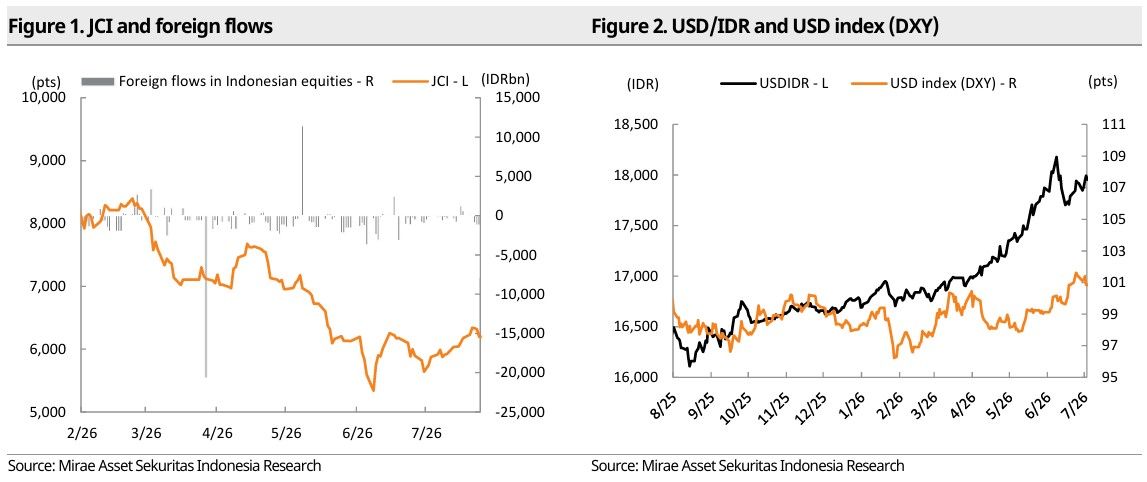
In the near term, the main transmission channel is likely to be through the Rupiah and domestic rates. The Rupiah could remain under pressure if the transition is perceived as weakening BI’s credibility, while BI may need to reinforce stabilization measures if volatility intensifies. This could also push bond yields higher as investors demand a larger institutional risk premium. The key issue for markets is whether the next appointment preserves institutional continuity and independence, as this could also shape the sovereign rating narrative over time.
Stay defensive amid volatility
Strategy-wise, a more defensive stance appears warranted. The preferred allocation is neutral on equities, underweight fixed income, and overweight money market funds. Within equities, BBCA remains the top pick given its relative defensiveness in a more volatile market backdrop.