
Mutual Funds vs Gold, Deposits, Savings & Stocks | M-FUND
When starting to invest, choosing the right financial instrument can be confusing. Some people prefer keeping their money in savings accounts or deposits, while others invest in gold, mutual funds, or stocks.
When starting to invest, choosing the right financial instrument can be confusing. Some people prefer keeping their money in savings accounts or deposits, while others invest in gold, mutual funds, or stocks.
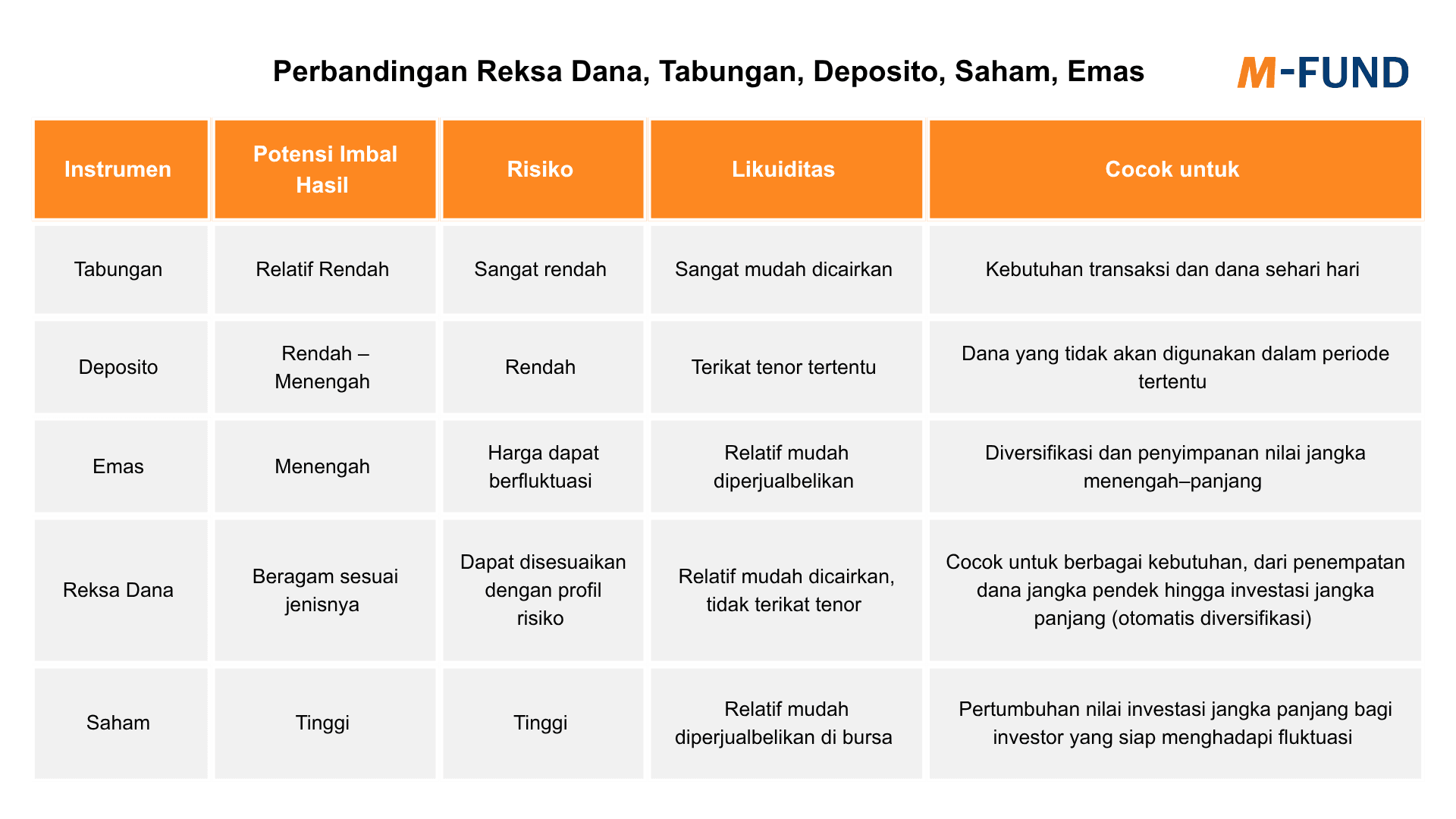
Each option has different characteristics in terms of potential returns, risk, liquidity, and investment horizon. So, what are the differences between mutual funds, deposits, gold, savings, and stocks?
What Makes Mutual Funds Different?
Compared with other investment instruments, mutual funds offer greater flexibility through different fund types that can be matched with an investor’s goals, investment horizon, and risk profile. Investors also do not need to select and manage each underlying asset themselves, as the portfolio is professionally managed by an Investment Manager.
Some key advantages of mutual funds include:
• Various options for different investment goals, from short-term to long-term investing.
• Professionally managed portfolios, so investors do not have to manage individual securities themselves.
• Built-in diversification, as one mutual fund may invest across multiple instruments.
• Affordable starting amount, from as low as IDR 10,000 depending on the product.
• Easy redemption with no fixed tenor, subject to each fund’s terms and conditions.
• Convenient, zero-transaction-fee investing through M-FUND.
These features can make mutual funds a practical option, particularly for investors looking for diversification and professional portfolio management without having to select individual securities themselves.
Types of Mutual Funds for Different Investment Goals
One of the advantages of mutual funds is the variety of products available for different investment needs.
• Money Market Fund are generally suitable for short-term investment needs of less than one year. They typically have relatively lower fluctuations compared with other types of mutual funds.
• Fixed Income Fund may be considered for medium-term investment horizons, with at least 80% of their portfolio invested in debt securities such as bonds.
• Balanced Fund offer a more flexible asset allocation because they can invest across equities, bonds, and money market instruments, with a maximum allocation of 79% in each asset category.
• Equity Fund allocate at least 80% of their portfolio to equities and are generally more suitable for investors with a longer investment horizon who are prepared for higher market fluctuations.
[Read more about the different types of mutual funds.]Link
Which Is Better: Mutual Funds, Deposits, Gold, or Stocks?
There is no single investment instrument that is always better for everyone. The right choice depends on your financial goals, investment horizon, liquidity needs, and risk tolerance.
Savings accounts may be more suitable for daily transactions and readily available funds. Deposits can be considered for funds that will not be needed during a predetermined tenor. Gold may provide an additional source of diversification for medium- to long-term allocation, while stocks may be more suitable for investors seeking long-term growth and who are comfortable with higher price fluctuations.
Mutual funds provide additional flexibility because they are available in different types that can be matched with various investment goals, risk profiles, and investment horizons.
Rather than looking for one instrument that offers the “best” return, investors can choose—or combine—different instruments according to their financial needs.
Start Investing in Mutual Funds Based on Your Goals with M-FUND[VS4.1]
Through M-FUND by Mirae Asset, investors can explore a range of mutual fund products based on their investment needs and risk profiles.
Before investing, make sure to understand each mutual fund’s characteristics, risks, and investment policy by reviewing its Prospectus and Fund Fact Sheet.
Disclaimer: This article is for educational and informational purposes only and does not constitute investment advice or a recommendation. Past performance does not guarantee future results. Investors are advised to read the Prospectus and Fund Fact Sheet before investing.
